Friday, April 11, 2014

Vamos al sur! Parada Nº 1: Mérida

After returning from my Valencia trip, I spent a week planning out an adventure on part of the Camino de Santiago, a famed pilgrimage from France to Northwest Spain. When the weather turned south, I took that as a sign and I went south too...to Andalucia!

Parada Nº 1: Mérida

This cat scared the living
daylight out of me.
My host, Vicen, has told me to visit Mérida, a city in the autonomous community of Extremadura, south of Castilla y León. The city is known for it's Roman ruins (which are all bundled together for tourists, I paid 6 euro for full access as a student)—as the city was once a major center for retired Roman soldiers, known as Emerita Augusta (notice the change from "Emerita" to Mérida, "Emerita" refers to "emeritus" soldiers who were retired and, moreover, retained status and honor). On my solo bus ride from Salamanca, we worked through the Extremadura countryside, featuring many hills, plains, and burros! 

Teatro Romano

This theater was constructed around 15 BCE and underwent renovation by Emperor Trajan. The theater shows a complete seating area (nobles sat at the front), and the theater includes a complete corridor, which ran beneath spectators. Marble structures litter the theater alongside a stage dominated by columns. In the summers, the city still uses the theater to put on classical productions. Here I started to realize that the best way to enjoy these sites would be to just take my time and soak everything in—so I just spent a few minutes sitting in the stands, imagining what the atmosphere must have been like over 2000 years ago.

Anfiteatro Romano

Immediately next to the teatro lies the city's amphitheater (8 B.C.), used for Gladiator combate between men and, on occasion, between men and animals. The amphitheater contains a very complete seating area and the city provides many educational materials including drawings of gladiatorial armor and descriptions of the different types of combat. My favorite part of this experience was descending through the gladiator entrance into the arena. That brought the history to life for me and seriously encouraged me to take my time in the area.


Acueducto de los Milagros

Translated as "aqueduct of miracles," this structure impressed me in a very different way from the aqueduct I saw in Segovia. The structure incorporates a mixture of brick and stone, something I began to notice quickly in the other ruins in Mérida. The brick helped because the Romans would have never found enough stone to keep up with their construction needs, and thus they used brick and stone, which remained very strong. Today 73 pilars of the aqueduct remain, though some are deteriorated. The use of arches in the pillars, combined with the brick and stone alternation arguably inspired the arches in the Mezquita de Córdoba (read onto "Parada Nº 2: Córdoba" for more).

Rápidamente:

Alcazaba de Mérida

The alcazaba, or fort, was a great surprise for me. Abd ar-Rahman II, moorish emir in Córdoba, built the alcazaba in the 9th century (he also played a role in the Mezquita de Córdoba). Again adding to its significance, the fort was the first Muslim alcazaba.
Old wall ruin. The moors used previous Roman and Visogoth structures to fortify.

Followed a staircase and found this water basin (referred
to as an aljibe or sótano). The coolest goldfish pond I've seen.

The large open area of the Alcazaba features an outdoor museum
with relics including Roman columns and complete coffins!

View of the building containing the water basin underneath.

On top of the water-basin building. This part was used as a small
mosque for soldiers and monks and was later converted into
 a church. The niche shown in the wall here is the mihrab, the sacred spot of the mosque indicating the direction of Mecca.

Arco de Trajano


This very out-of-place arch, referring to the Emperor Trajan, was the main access point ("puerta de acceso") to the city's sacred temple district. The arch sits between two modern buildings built straight into the arch, showing how the city naturally melded the new into the old. To me, this was actually quite cool—even though it tampers with the ruin a bit.

Plaza de España

This main square impressed me, especially with the bright yellow-and-white town hall. The plaza doubles as a patio, with orange trees scattered throughout. Orange trees signify warm weather...now time to go southward!


Puente Romano

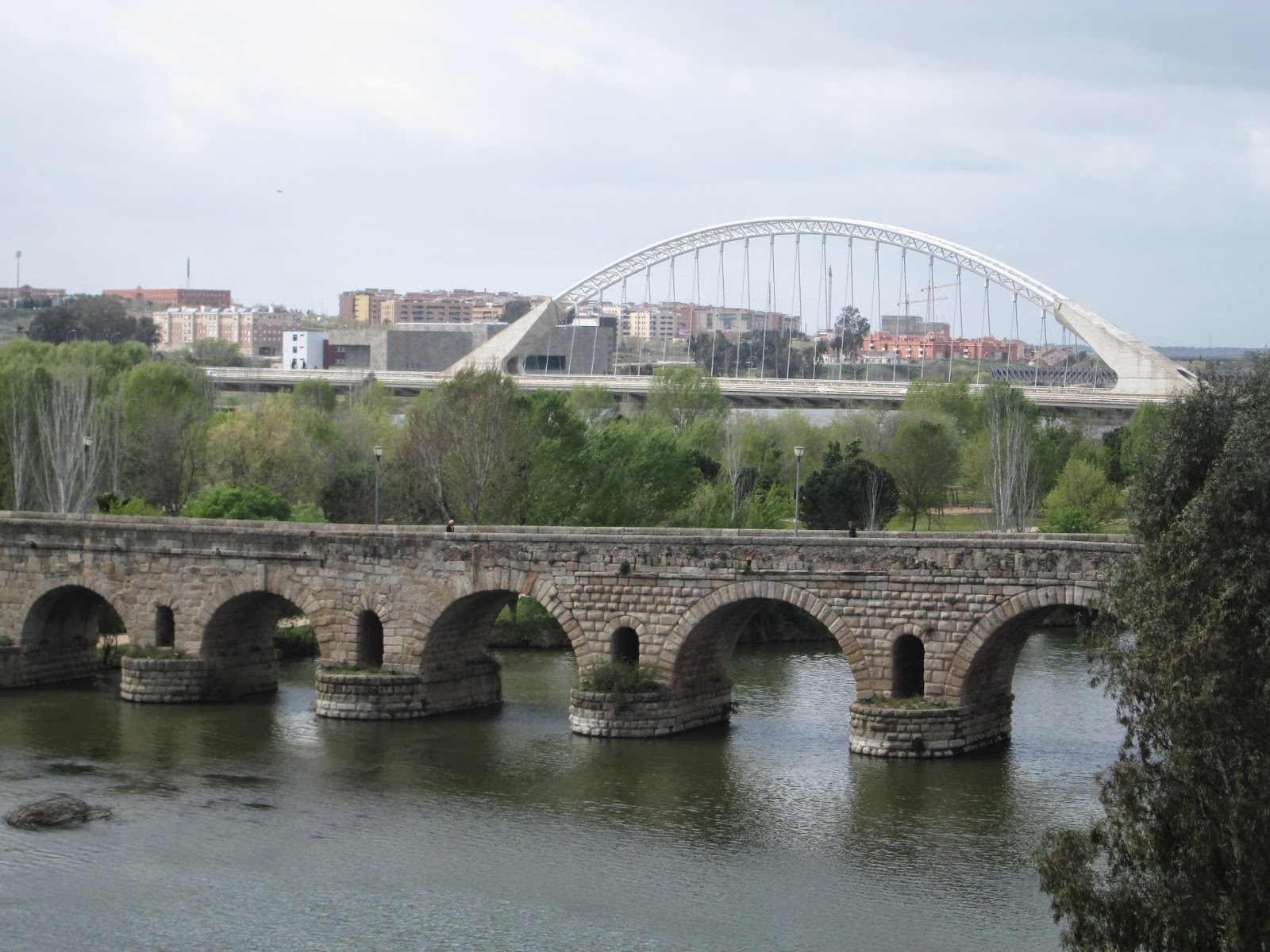
Near the Alcazaba lies the Puente Romano, the longest surviving bridge from ancient times! The bridge is about 750 meters long!


Las Fallas


Above the hoards of people in the streets loom large cartoonish and almost nightmarish statues in Valencia’s famed holiday, Las Fallas. The tradition involves carving colossal sculptures out of wood and papier-mâché in a satire depicting religious symbols, crimes, and politics. 
Each sculpture, or falla, has a similar style that can only be described in pictures (think of adult-themed Disney cartoons in three dimensions). At the end of a few days celebrating, people take to the streets to watch others light the sculptures on fire in the middle of the city, with the fire department managing the chaos as flames shoot up along nearby buildings.
Though I didn’t actually stay for the cremación, I experienced the stellar atmosphere with a good group of friends from Salamanca:
Fuegos Artificiales:

Las Fallas ceremonies include an absurd amount of fireworks shows and in the two days I spent in Valencia we saw one show by day and another by night. The daytime show came as a big surprise. Sealed in a slow-moving crowd, we felt the ground shake and saw more smoke than colors as a rapid-fire ensued. Surrounded by buildings in the central Plaza del Ayuntamiento, each shot reverberated and the spectacle quickly overwhelmed me. Our small group saw a group of adamant musicians playing flutes and drums while dancing and singing—inspiring others to chime in.

Playa de Arena:
I happily sank my feet into the sand and later enjoyed a paella valenciana and pez espada (swordfish) at a beachside bar. With sunny skies and the warmest temperatures I experienced since arriving in Spain, this spot naturally turned into a go-to destination.

Jardín del Turia:

After the “Gran riada de Valencia,” the city’s greatest flood, the city decided to create a place for locals and tourists alike to take calming strolls (in Spanish people say ”dar un paseo”) through nature. The park snakes through the city and offered a great contrast between nature and city—offering an escape without leaving urban commodity. I thought the water features were spectacular, particularly the “Fuente del Jardín” located close to our apartment. One of the weirdest/coolest parts of the park for me was a play structure made to look like a man lying down.

Mercado Central

A great spot to grab some cheap eats or prepare for a quality home-cooked meal. I snagged an empanada filled with morcilla (blood-sausage) and a fresh glass of kiwi juice.


Sunday, March 9, 2014

Standing in the English rain

I never thought I’d have the opportunity to visit London. All my life I’ve dreamt about going and, last weekend, my dreams were matched by reality.
We stayed in Paddington from which we were able to travel throughout London proper with ease.

Here are my favorite moments:

Bus Tour

Led by a tour guide, Ingrid, we had the chance to whiz by major sights including Westminster, St. Paul’s Cathedral, Buckingham Palace, and the Tower of London. As we passed monument after monument, I realized I had some major decision making ahead of me, as many opportunities await tourists in the city.
When we passed the Savoy Theater and Ingrid mentioned that "Dirty Rotten Scoundrels" was playing there, starring Robert Lindsey, one of my favorites (from one of my favorite British comedies, "Spy").
Ingrid also talked about the presence of Qatari's across the city, funding projects like the Shard—tallest building in London, Harrods, and a series of apartment buildings with the highest real estate value in the city, equating to tens of millions of dollars per flat.
About half way through the tour, we made our way to Buckingham Palace and watched the changing of the guard amongst a large crowd. This was the moment in which—apart from enjoying the guard—I became aware of the diversity in London just by listening to the many languages I heard in the crowd. I believe I heard Arabic, mandarin Chinese, French, Spanish and German, but I cannot be entirely certain about all of them.
When we passed by St. Paul’s (a place I didn’t make it back to, unfortunately) Ingrid talked about the colossal effort of volunteers, known as St. Paul's Watch, to protect the Cathedral from damage during the World War II blitz. Had it not been for those volunteers, the Cathedral would not be in the shape it is today. The theme of wartime camaraderie would return even stronger for me later in the trip as I visited the Churchill War Rooms (read on for more).

Westminster Abbey

A few hours after our bus tour (which ended at Covent Garden), a few friends and I grabbed lunch and toured the city—eventually ending up back at Westminster—where we marveled at the houses of parliament and the Elizabeth Tower. Soaked by the English rain, we luckily arrived in time for a service at the equally astonishing Westminster Abbey. A site of coronations (from William the Conqueror), burials (including Charles Darwin, Ben Johnson, Charles Dickens and Sir Isaac Newton—among others) and royal weddings (obligatory Kate Middleton and Prince William comment here), the church is steeped in history. The acoustics in the building for the choir combined with a powerful silence in moments of prayer made for a unique sensory experience—though I would have liked a tour to learn a bit more about the building’s history.

British Museum

Impressed by the building alone, I entered with little idea of the millions of artifacts awaiting me inside. Our tour guide told us about the importance of the library inside the building, used by people like Marx (to write the Communist Manifesto) and Lenin.
*Food for thought: Individual panes of glass cover the “courtyard” inside the British Museum—between the outer building and the library.  The inner building is not exactly centered so, to give the appearance of symmetry, a team of designers used a computer program to create a glass ceiling that, using pieces of glass, could give the illusion of symmetry in the courtyard area. Each pane of glass has a unique shape.
Among our selected sites, we saw the Rosetta stone (with Egyptian hieroglyphs, Demotic writing, and Greek), part of a statue of Ramasses II, the Sutton Hoo Burial with Anglo-Saxon artifacts, and Cleopatra’s sarcophagus. Apart from these major artifacts, we saw a collection of African art including a throne constructed from weapons (including swords and firearm magazines), expansive collections of Greek and Roman art, and briefly looked at a few other exhibits including one on the history of clocks and timekeeping and another on the historical significance of money.
As I walked through the massive libraries and saw thousands of bookshelves alongside major artifacts I thought about how the museum was, by far, the most iconic building for history that I had ever seen in my life. I hope I can return and, for those of you that want to visit London, make sure to get in a full day at the museum—my time there was rather short. I will post pictures of the museum in the slideshow feature.

London Eye
The London Eye is the largest Ferris wheel in Europe. In a slow rotation, the ride is very comfortable and you are able to walk around the pods and take in a panoramic view of the city—looking down areas like Westminster to the major modern buildings (e.g. "the shard," "walkie talkie,") of London.


Churchill War Rooms

Down below the Treasury building in Westminster and beneath a layer of reinforced steel and concrete known as “the slab” lies one of the best kept secrets in London and my favorite place I visited. From these rooms, Winston Churchill directed the war effort in World War II. Spending 15 hours a day working with a devoted staff of military directors, civilian typists, and media personnel, many worked under artificial light for hours as bombs reined down on the city. From this concrete cave, instead of misery arose determination and heart as these qualities emanated from Churchill.
We slowly made our way from room to room—from his transatlantic telephone room where he communicated with other world leaders (as demonstrated in our audioguide through a reenacted transcript between Churchill and FDR), to his bedroom, to the dining room, to the media control room, to the map room—used by the Royal Navy, British Army, and Royal Air Force.
Map Room in the Cabinet War Rooms, Copyright Kaihsu Tai
In addition to the war rooms, there is a massive museum housed underneath as well. With pieces including Churchill’s preferred one-piece suit, his cigars, sunlamps used by those with him, a lock of Churchill's childhood hair, and private letters between Churchill and his wife Clementine, I would describe the museum as thorough, to say the least.
In addition to many of Churchill’s personal effects, I found the amount of supplementary material including a thorough audio guide accompanying each room and area of the museum, video testimonials from those who worked with Churchill, and recordings of Churchill’s speeches to be fascinating. Additionally, the museum has a light table where visitors can search by year and month and pour through important dates and documents from Churchill’s life and career.
Churchill served a prescient purpose in making bold predictions and staying true to his convictions. The museum gives a very unbiased portrayal of the man and, even after looking through some of his flaws (including opposition to India’s independence from Britain), I felt inspired by the guy. He followed his intuitions about Hitler, he thought highly of his company (in both his experience as a soldier and leader), and he thrived under pressure—though he fatigued greatly because of it.

Rapid Fire:

St. James Park

Located in front of Buckingham Palace, this park has ponds and lush greens, alive with squirrels, pelicans, swans, and ducks. This was one of the most idyllic city parks I have been in and, though I couldn't make it to the vast Hyde Park, I realized why London is renowned for its parks—more than any other large city in Europe.


King’s Cross Station, 221B Baker Street

Needed to add these two locations to my list, even if just for a few moments. I took the tube (metro) to these two places and had fun reliving some of my favorite childhood film/book interests at platform 9 and 3/4 and outside Sherlock's mythical apartment.


Camden Market

Filled with tourists, trinkets, and food—Cambden Market could easily take days of exploring. Unfortunately, I only had an hour and a half. For that reason I explored shops quickly and shoveled in a burrito before catching the tube back to the hotel for our bus back to the airport.

Sevilla y el sabor de Andalucía

Sevilla felt a lot like one of those dreams where no matter how hard you try to run, you still end up moving slowly. Sevilla's bustling social atmosphere and its many attractions including massive parks, towers, and cathedral were just enough to make me appreciate life in Andalucia, the southernmost autonomous region in Spain, the likes of which Sevilla shares with cities like Granada, Córdoba, and Cadiz.

Highlights

Flamenco

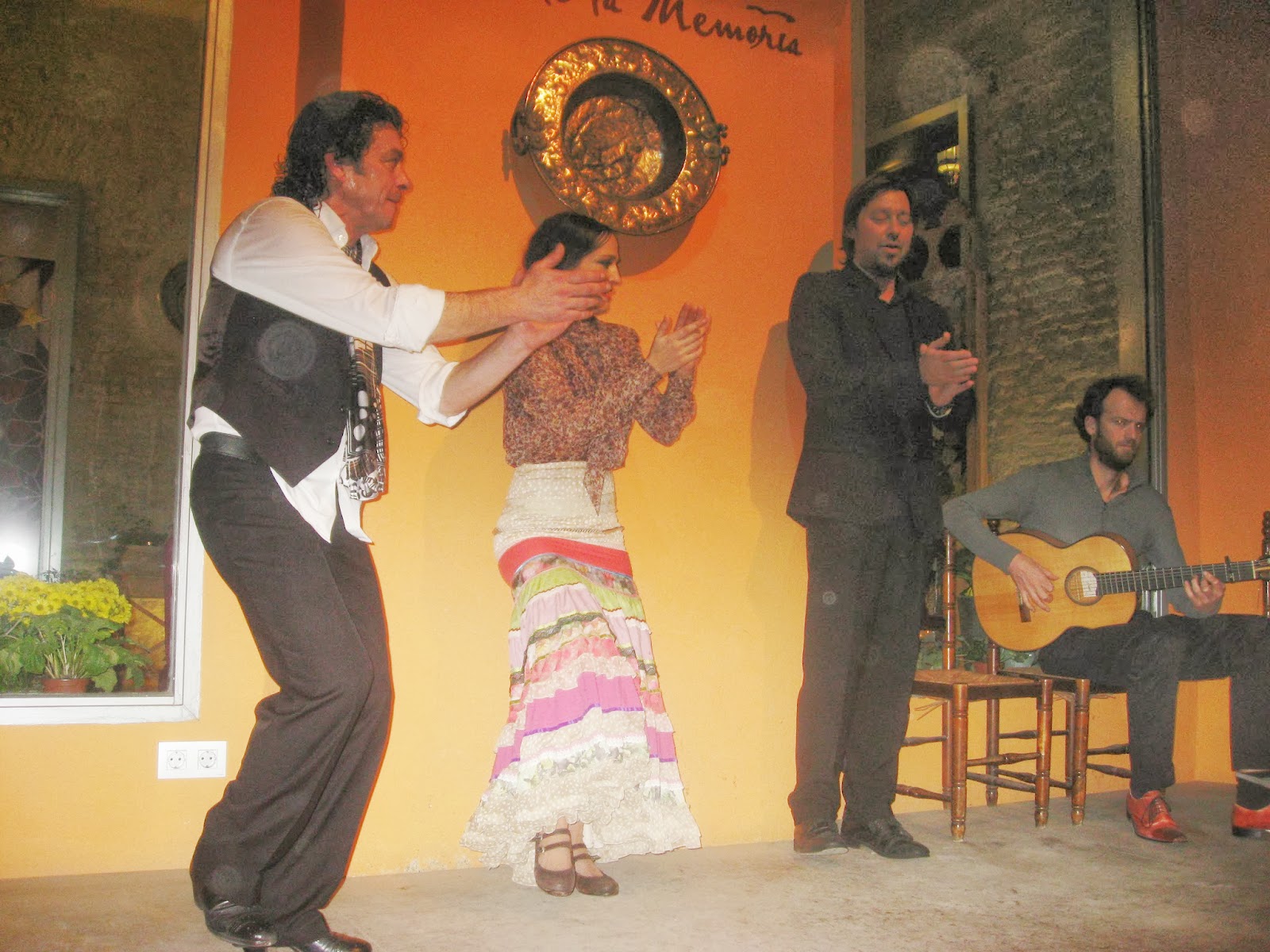
I can honestly say I emotionally invested in this performance. The stage was simple: slightly elevated with two chairs. Broken up into acts, the performance used only four people (in different combinations and varying tempos). The vocals, (cante) performed by one male singer in this case, made for a melody unlike anything I'd heard before—and clearly shows a mix in its Arab and Spanish roots—almost like a mix between a prayer call and a forlorn love song. In between the vocal range of the singer and the sporadic guitar (toque) skills of the guitarist, the dancing (baile) put the show over the top for me. One man and one woman clapped their hands (called palmas) and danced with extreme precision. As I watched their feet quickly and violently slamming against the dance floor (verb in Spanish: taconear) it was obvious that they had all poured years into their artform.

Torre del Oro

My favorite building in Seville. Built in the 1200s, this tower served a Moroccan dynasty (Almohads) to control port access to Seville. The tower, this is now according to Wikipedia, is built from mortar, lime, and pressed hay. Apparently, there used to be another tower on the other side of Rio Guadalquivir and people would drag a chain across to block off the river. Unfortunately, I didn't make it to the naval museum inside the tower, but it was a joy to look from the outside.
Parque de Maria Luisa, Plaza de España
Aside from this being used in Star Wars, this park was built for the Ibero-American Exposition World's Fair in the1920s. The park includes fountains, ponds, and a variety of tropical trees. The plaza itself, the major feature of the park, includes a small moat around the edge where people rent row boats and enjoy Sevilla's sunshine. An art deco masterpiece, the plaza also boasts impressive brickwork with tile inlays—all kept pristine. The plaza today includes the town hall, and a few museums. Since we had free time, we rented what I call "bike carts" (pretty much a pedal-powered golf cart) and rode through the park's paths (these pictures will be added to a Sevilla slide show).

Alcazar
This building was initially a Moorish fortress and is the oldest palace still used in Europe. The building contains examples of "mudéjar" architecture, meaning it was built by Muslims during Christian times. My favorite feature was the integration of Roman columns in the building (as the mudejares used the Roman remnants to support their structures, making for less work). This is made even more interesting by the Romans' use of prehistoric artworks and stones to build their structures (making for a repeating pattern, at least to me).
The upper levels of the Alcazar are used for the royal family of Spain, though the family hasn't visited in years. Still, people maintain the rooms in the event they decide to show up (this made me feel for those that have to maintain the rooms for no particular purpose).
We visited Los Baños de María de Padilla and also made our way to La Casa de Contratación (house of trade) where Columbus met with Ferdinand after his second journey. The chapel contains one of the first paintings of the discovery of the Americas.
Also, there is a fantastic garden (of course) with a labyrinth, fountains, and buildings made for the Andalusian summers.

Plaza de Toros de la Real Maestranza de Caballería de Sevilla

This is the oldest bullring in the world. During the Seville Fair in Semana Santa, the plaza has one of the most renowned bullfighting events in the world. Here, bullfighting on foot began in the 1700s. WIth a guided tour, we looked at art pieces depicting bullfights, some sculptures, matador (or torero) outfits, and bull heads placed around the ceiling (which made me feel quite uneasy, to be honest). Apparently, when a matador has done well, he may be awarded between one and two of the bull's ears, and also the bull's tail. Because I feel weird writing about this, I'm going to move on!


Catedral de Sevilla

La Giralda
Small view of part of the Cathedral's
 exterior.
Finally, we make it to the Sevilla Cathedral
(Catedral de Santa María de la Sede). us's body. This Roman Catholic Cathedral is the largest Gothic cathedral and third-larges church in the world. It was completed in the 16th century. The Cathedral is actually an adaptation of an ancient mosque. The minaret (used to call Muslims to prayer) converted into a bell tower (La Giralda) and the orange tree patio (Patio de los naranjos) are the two remaining elements of the mosque. The rest pertains to the 16th century cathedral.

There are 15 elaborate entrances to the Cathedral. Inside, there are 80 chapels. Here are the dimensions to give you an idea of the size of this building: Length 443 ft * Width 330 ft (at nave,main body of the church, 49 ft) * Height (138 ft). Meant to demonstrate the city's wealth, I'd say the builders completed their goal. There is a massive altarpiece inside depicting the life of Christ and was the work of one craftsman. Unfortunately, the piece was under renovation when we visited.

Rapid fire: The good and the weird (not mutually exclusive)

+Eating bull tail at a tapas bar
+Seeing a Spaniard playing American folk music outside the cathedral
-Watching a pack of wild cats devour a dead animal in a gully
-Nearly stepping on a vendor's "artfully-placed" collection of paper fans meant to catch tourists off guard


Friday, February 28, 2014

Ávila, away!

R.I.P. Canon PowerShot
This weekend, I spend a day in Ávila, a city about an 1 1/2 hour outside Salamanca by train. As I walked on its medieval wall, I tripped, and watched in horror as my digital camera careened into the distance. I made sure to look away but I'm pretty sure I heard the sound of it smacking into the ground. Then, as I frantically descended the steps of the wall to retrieve it, I noticed a man ha
d it in his hands and was walking away with it! After chasing him down, I got it back. I probably should have just let him take it because the thing is completely busted. Since then, I have replaced ye olde Canon with another 80 euro Canon camera.


Luckily I managed to retrieve a few photos before my camera gave out. I'll keep this to a photojournalism post, with pictures and detailed captions.

Basilica de San Vicente is an example of Romanesque architecture.
According to legend, St. Vincent was buried here and then the
basilica was built over their tombs. 
There is a 15th century Asian-like canopy that
 stands above the sarcophagus of Saint Vincent, shown on the right.

Me on top of the wall (muralla) of Ávila.

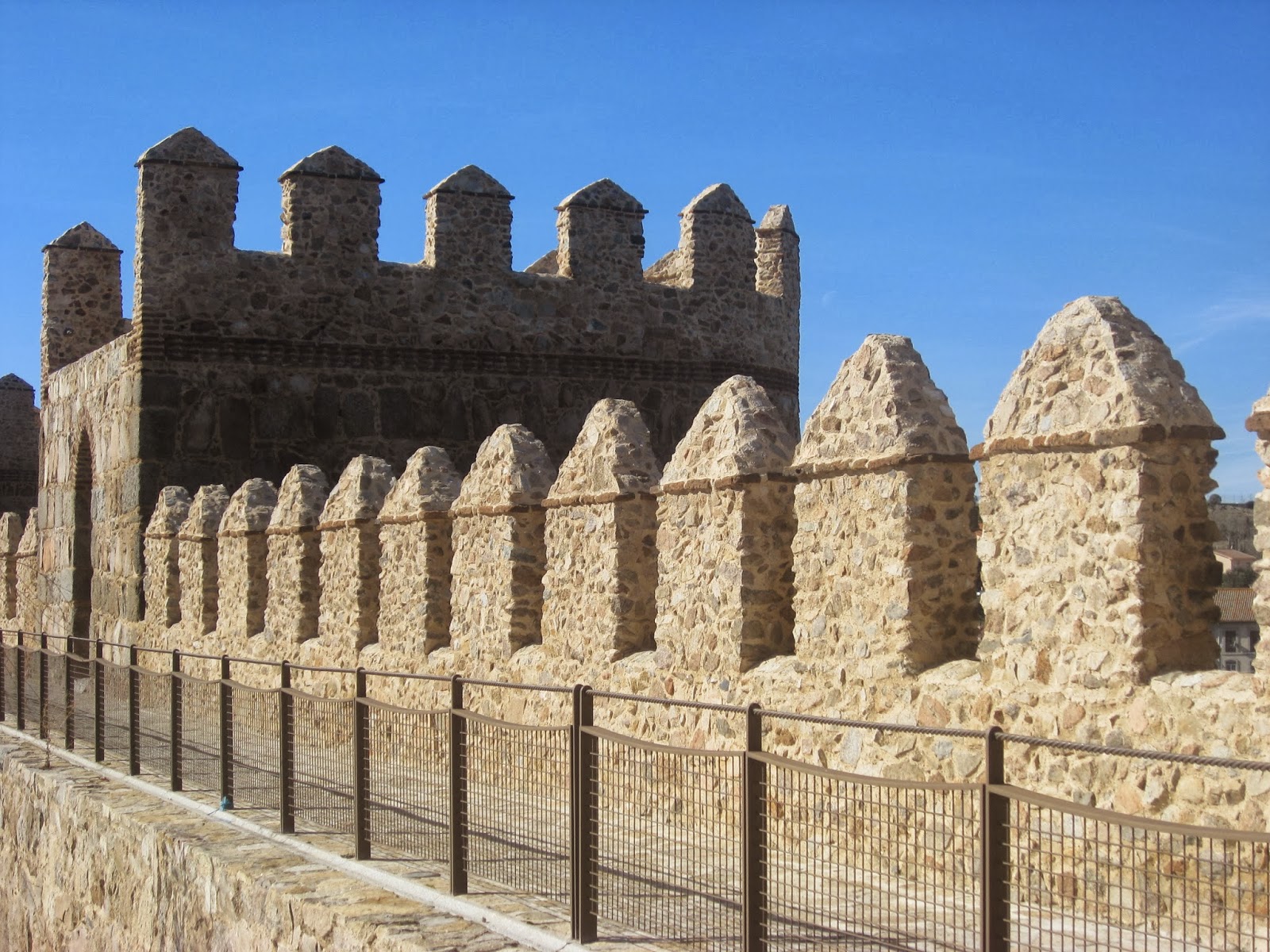
Las murallas de Ávila were completed between
11th and 14th centuries. These are the most complete
fortifications in Spain. There are 88 towers and the wall spans 2,516 meters.
The Cathedral in Ávila was built straight into the
wall and is considered to be the first Gothic Cathedral
 in Spain. It was planned as a Cathedral/fortress.
Another view showing the Cathedral built into the wall.


Plaza Mayor of Ávila.

View of the walls and buildings inside the walls.